
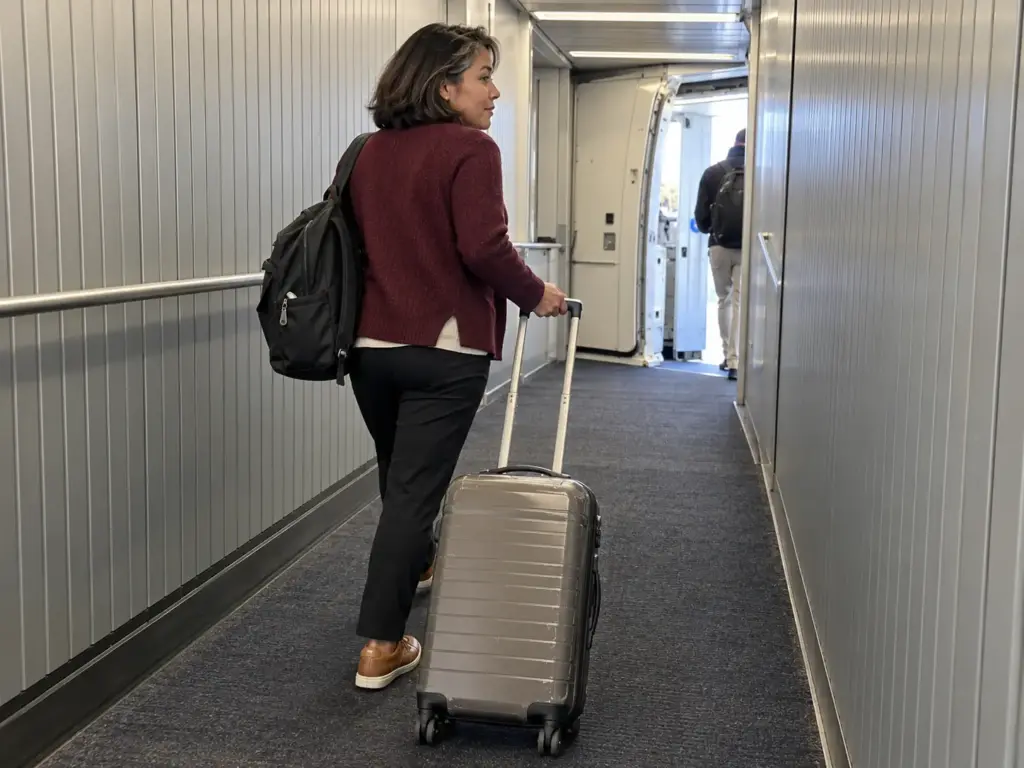
Your roller passed the tape measure in the hallway, and then you reach the door of the plane and the bin above row 12 is already shut. That’s the part of the United rule that a number can’t settle, and it’s why a bag that measures right still sometimes ends up in the hold. The sizes below come straight from the carry-on page on United’s own site, as read in October 2026, and what follows covers the two limits, the fares that include the bin, what gets a good bag checked, what that costs, the free fixes, and the bags whose listed sizes meet the rule.
Quick Answer
United’s carry-on limit is 9 x 14 x 22 inches (23 x 35 x 56 cm) with the handle and wheels counted, and its personal item is 9 x 10 x 17 inches (22 x 25 x 43 cm), per United’s baggage page in October 2026. On most Basic Economy fares, only the personal item rides free.
Both United Limits, With the Wheels and Handles Counted
The number itself is short. What trips people up is what United counts as part of the bag, and that the two limits share one measurement you’ll break first.
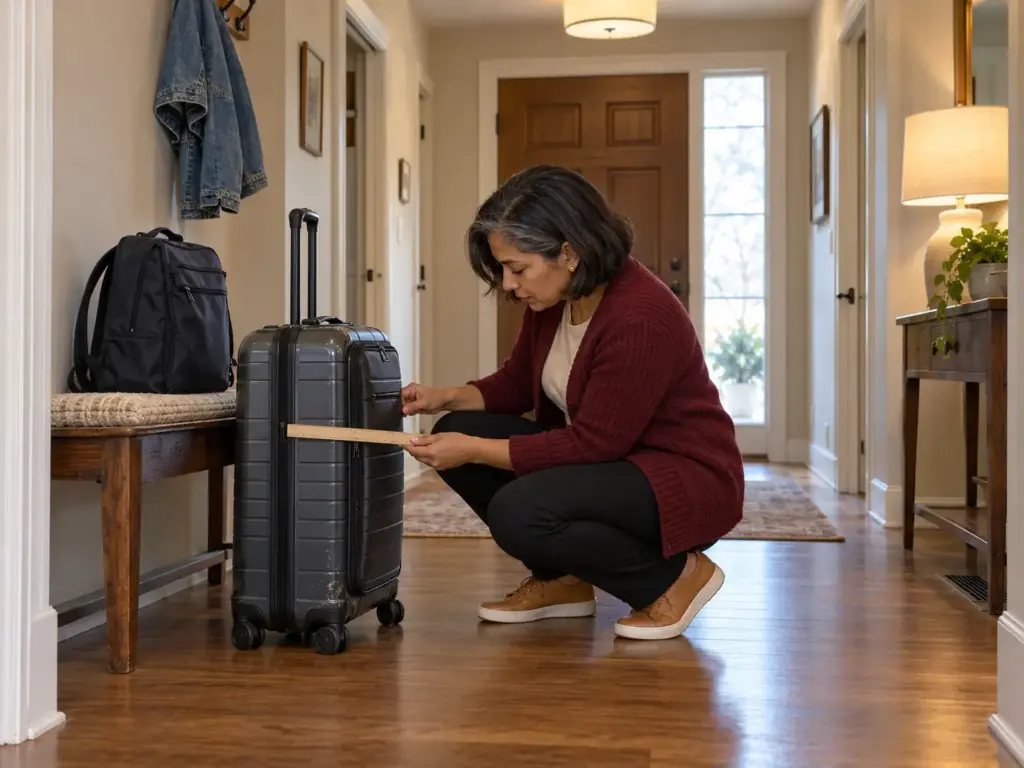
The carry-on: 9 x 14 x 22 inches
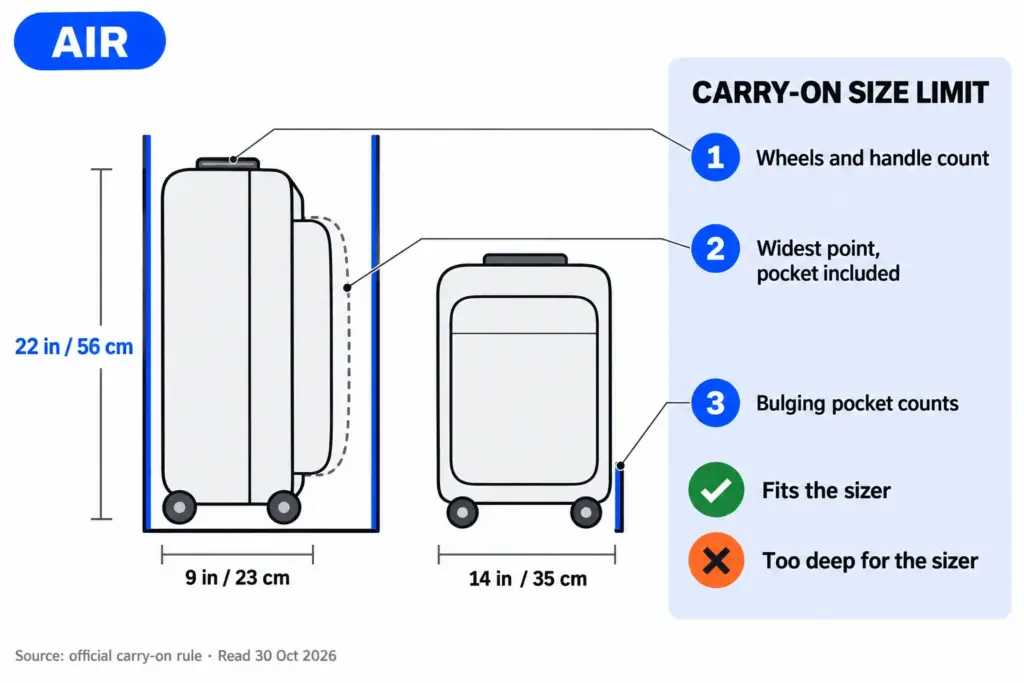
The United carry-on size limit is 9 x 14 x 22 inches (23 x 35 x 56 cm), and those carry-on dimensions include the handle and the wheels when you measure. It adds that the bag has to fit in the overhead bin, so there are really two tests: the printed size and the space above the seat.
United also says its bag sizers at the airport can measure the bag for you. That makes the sizer a free check you can use before you commit to a boarding line, though it only tells you about the size, not about the bin.
The personal item: 9 x 10 x 17 inches
The personal item is the under-seat bag: it has to fit under the seat in front of you, and United prints it at 9 x 10 x 17 inches (22 x 25 x 43 cm). Purses, backpacks and laptop bags are the examples the page gives. Notice the depth: it’s the same 9 inches as the carry-on, so a personal item with a bulging pocket breaks the very number the carry-on breaks.
| Bag | Size in inches | Size in centimeters | Where it goes |
|---|---|---|---|
| Carry-on | 9 x 14 x 22 in | 23 x 35 x 56 cm | Overhead bin |
| Personal item | 9 x 10 x 17 in | 22 x 25 x 43 cm | Under the seat in front |
Sizes as printed on United’s carry-on page, read October 30, 2026; the carry-on size includes handle and wheels.
Check the 9-inch depth first and the 22-inch length last. Length has room to spare on most rollers, while depth is where a full front pocket or a bulging zipper pushes a bag over the line.
Measure it packed, handles and wheels out
A tag that says “carry-on” is a sales word, not a measurement, and many makers size the shell and leave out the wheels and the handle that stick out of it. A 22-inch shell with wheels underneath is taller than 22 inches. If you want the full explanation, there’s a separate piece on whether wheels and handles count toward carry-on size; here the only thing that matters is United’s wording, which counts both.
Soft-sided bags are the sneaky ones. Empty, the bag sits flat and the tag looks honest, but once a jacket and a pair of shoes go into the front pocket, you get a bulging pocket and a bag deeper than 9 inches that stays that way. Measure at the fullest point, with the bag packed the way it will actually travel.
If your bag lands inside both numbers, that’s good news, but it’s only half the picture, and how the other big airlines compare matters if your trip has a second carrier on it.
Why Your United Fare May Not Include the Overhead Bin
The sizes only apply if your fare includes the bag they describe, and on United that isn’t a given. The cheapest fare on the screen can look identical to the next one up until you read what comes with it.
Basic Economy: one personal item
Under United’s current rules, a Basic Economy ticket includes one personal item and no carry-on, with one big exception: flights to South America, across the Atlantic or across the Pacific keep the carry-on. If you’re flying a domestic route on Basic Economy, the overhead bin is simply not part of what you bought. The bag fits United’s sizer fine, and it still isn’t allowed on board for free.
The difference between a carry-on and a personal item is more than size, and how the two limits differ is worth a read if you’re deciding which bag to pack for a cheap fare.
The routes and the people who are excepted
United also lets some Basic Economy travelers keep the carry-on: MileagePlus Premier members and their companions, primary holders of qualifying United credit cards, and Star Alliance Gold members. The page is specific that the United Gateway and MileagePlus Select cards don’t qualify, so holding a United card isn’t automatically enough.
The fare type belongs to the ticket, not to the bag. The same roller is fine on one booking and a checked bag on the next.
Where to look at booking
Before you pay, open the fare details and find the line about bags. If the carry-on isn’t listed there, you have two options: pack for the personal item alone, or plan for the fee in the section after next. Deciding this at the booking screen costs nothing, while deciding it at the counter doesn’t.
When a Bag That Fits Still Gets Checked at the Door
The sizer settles the bag, but it doesn’t settle the bin, and the bin is what boarding runs on.
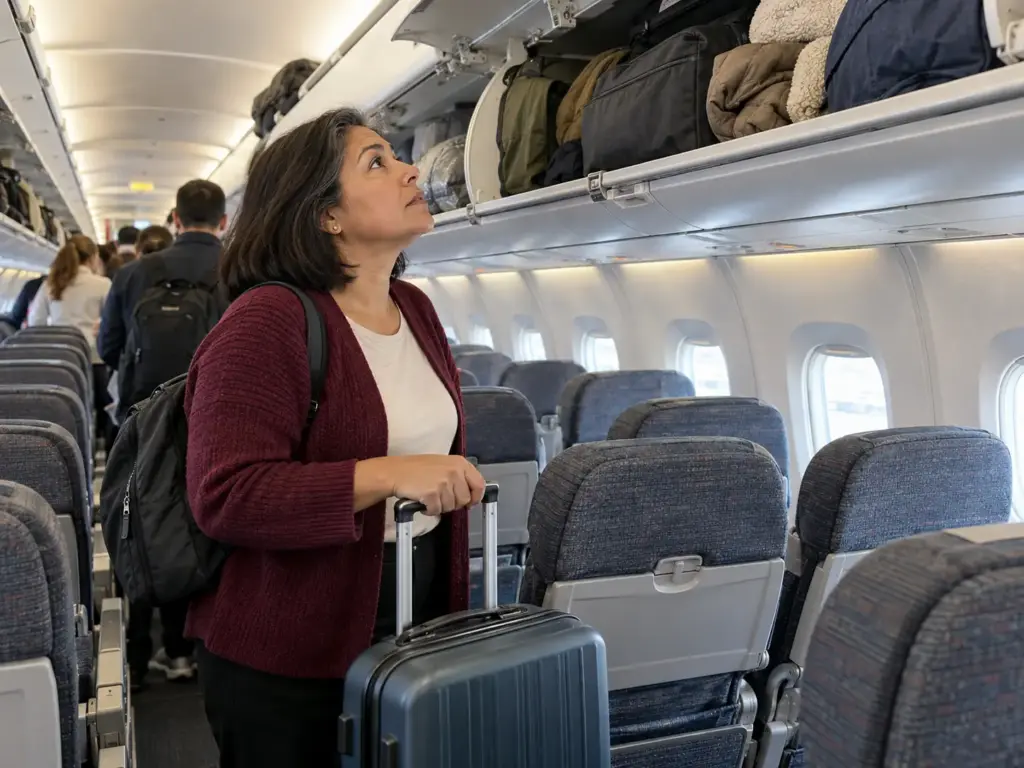
The three reasons United checks a carry-on
According to United, “Your carry-on bag must fit in the overhead bin,” and the page names three situations in which a carry-on may be gate-checked: the plane runs out of overhead space, an oversize bag, or you’re over your carry-on allowance. The first one has nothing to do with your bag at all.
That’s why enforcement at the door feels uneven. Some oversized bags board without a word, and some perfectly legal rollers get tagged, because the people who board near the end meet bins that are already full. The best you can do is read your own boarding position and plan around it. A compliant roller in a late boarding group on a full mainline flight is exactly the bag the first trigger catches.
Why the regional leg is the first to fill up
Many United flights are flown by regional partners under the United Express name. The page says bags are most frequently gate-checked on those flights, and spells out the limits: CommutAir passengers may carry only one personal item, and the other United Express carriers allow carry-ons but with limited space. A carry-on that’s correct for United’s mainline limit can be the first bag checked on a regional jet, because the bin it was measured for isn’t up there.
Open your trip in the United app and look at each flight segment. It states which carrier operates it, and any leg on a United Express partner is the one where a roller is most likely to go below.
What stays with you if the bag goes below
United says to put medication, vapes, e-cigarettes, keys and other essentials in the personal item, in case your bag is gate-checked. That’s a travel rule about what stays within reach. If a prescription is part of the trip, your doctor or pharmacist is the one to ask how much to bring; the airline’s rule only covers where it rides. Add the chargers and anything breakable to that list, because a gate-checked bag rides in the hold with the rest.
On most United flights a gate-checked bag comes out at baggage claim at your final destination. On United Express flights it may come out at baggage claim or on the jet bridge after arrival, so listen for the announcement before you leave the plane.
If it happens to you, what happens to a carry-on that is too big at the gate is the follow-up question, with the options laid out.
What a Gate-Checked Bag Costs on Basic Economy
Getting checked at the door costs little drama on a standard fare, and a lot more on Basic Economy, where the number depends on the day you bought the ticket and where you pay.
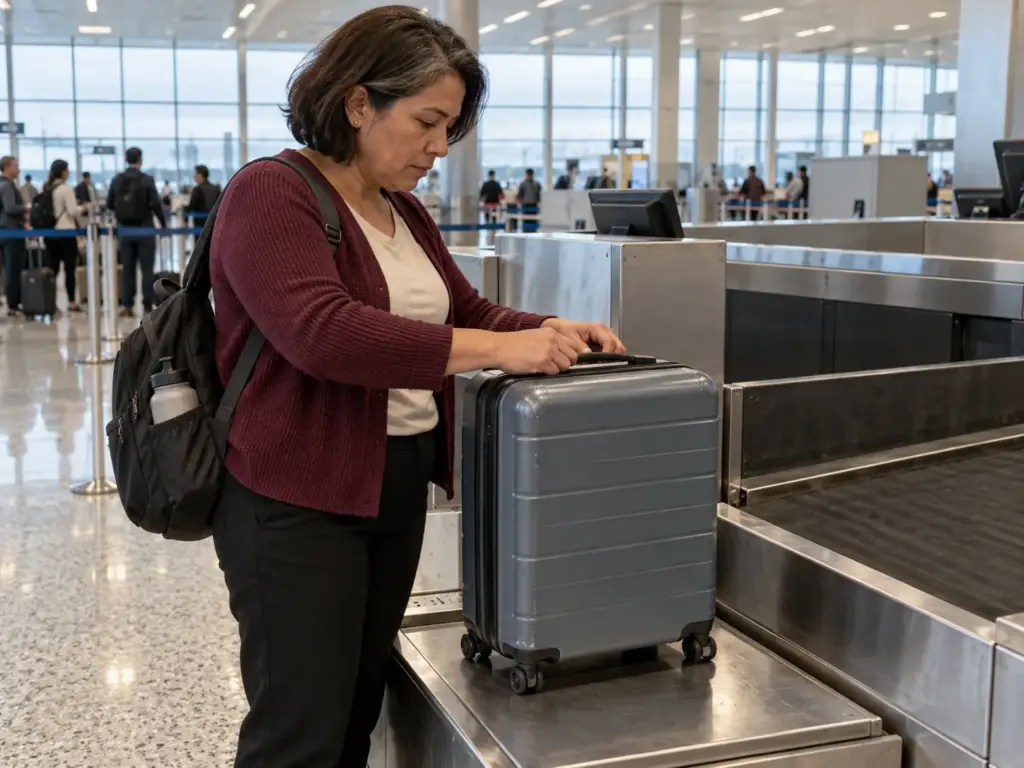
The Basic Economy figures
These are United’s own figures, read on October 30, 2026. For tickets bought on or after April 3, 2026, a bag costs $75 at the gate, $45 if you prepay, and $50 in the lobby. For tickets bought before that date, the same three are $65, $35 and $40.
Notice that the purchase date, not the flight date, decides which set applies. A ticket bought in March for a December flight is still on the older, cheaper schedule.
The gate fee is the checked-bag fee, and the pattern at the door is that it gets charged whether or not the bin is full. Paying before you reach the airport is the cheaper path in both schedules, as United’s own price ladder shows. If your bag is only a hair over the limit, what to do if the bag is only slightly too big covers the near-miss case that this fee punishes.
Find the purchase date on your booking confirmation before you do any math. A $10 gap between the two price schedules is easy to miss, and it applies to every bag you add.
The standard-fare wording
For fares above Basic Economy, United’s page says only that you may have to pay a fee for a bag that has to be checked, and it points to the bag fee calculator for the exact amount. No gate figure is listed for a standard fare, so the number to trust is whatever the calculator shows for your ticket on the day you book. Don’t assume a second “handling” charge sits on top of the fee: the owner prints one figure per fare.
The Free Fixes to Try Before You Buy a New Bag
Almost every fix here costs nothing, and the order matters, with a measurement between each move. Run through them in sequence before you think about a purchase.
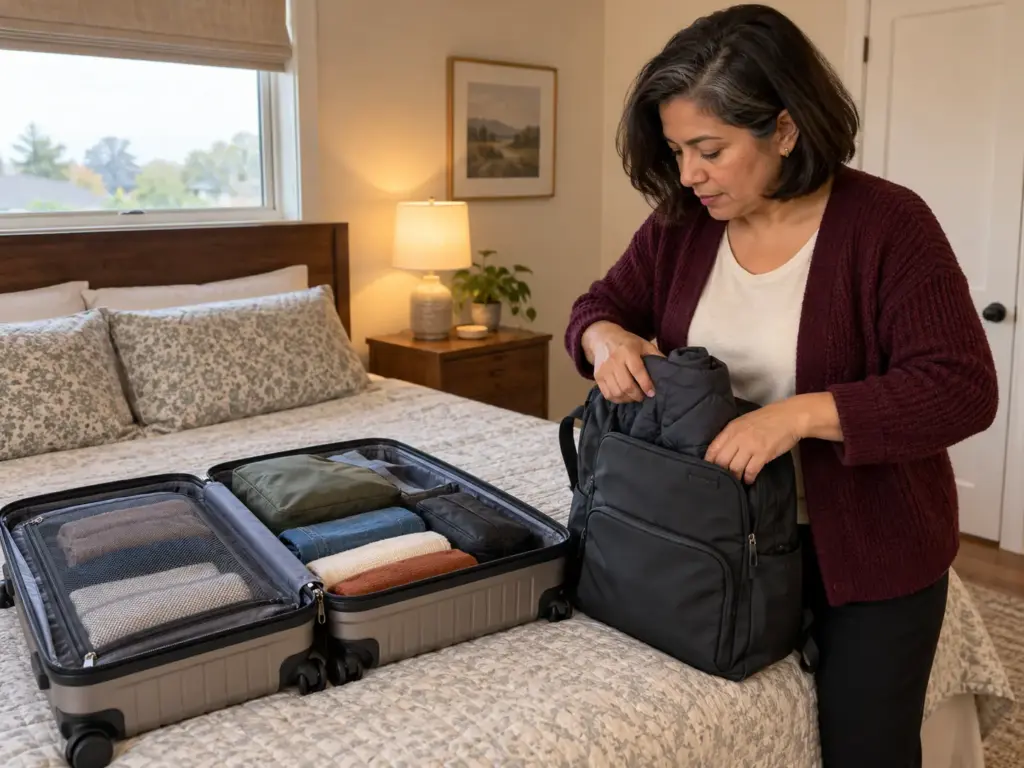
Measure the bag packed, then measure again
Start with the bag you own. Pack it for the trip, stand it up, and measure the height with the handle down, the width, and the depth at the fullest point. Compare each number with 9 x 14 x 22 inches (23 x 35 x 56 cm), and ignore what the tag says. If you want a longer walk through the process, there’s a guide to how to tell if your carry-on is too big.
When the depth is the problem, empty the front pocket and measure again. A soft bag compresses; a hard shell doesn’t. A hard shell with an expansion zipper gets measured closed, because that’s how the sizer will see it.
Make the carry-on a personal item
If it still doesn’t fit, move the heavy things and the ones you can’t replace into the personal item (9 x 10 x 17 inches, or 22 x 25 x 43 cm) and ask a blunt question: could this trip work on that bag alone? On Basic Economy it’s the only bag guaranteed, and for a short trip it often works better than people expect, especially if you wear the bulkiest layer on the plane.
Pack so the bag survives a gate check
Pack as if the carry-on will be handed over at the door, even when you expect it to stay with you. Medication, keys, vapes, the power bank and the charger ride in the personal item.
Liquids go there too, in containers of 3.4 ounces (100 mL) or less, all inside one quart-size bag that’s clear and sealable. That’s the rule on TSA’s What Can I Bring? liquids table as read in October 2026, and the 3-1-1 liquids rule has its own explainer. United’s page adds that powders up to 12 ounces (350 mL) can ride in the carry-on on domestic flights.
Once those moves are done, you can ask whether the bag itself is the problem.
Bags That Meet United’s Numbers on Paper
If the measuring says the bag is wrong, here are four whose makers’ numbers meet United’s limits, with what each one gets wrong. Whether paying for more size makes sense at all is a fair question too, and there’s a piece on whether a bigger carry-on than your airline allows is worth it. We chose these four by the four checks: United’s own page, the maker’s listed exterior size, the problems that keep coming up in buyer reviews, and the warranty. Every size below is the one on the maker’s Amazon listing, so it’s worth confirming against the listing for the exact color and variant you open.
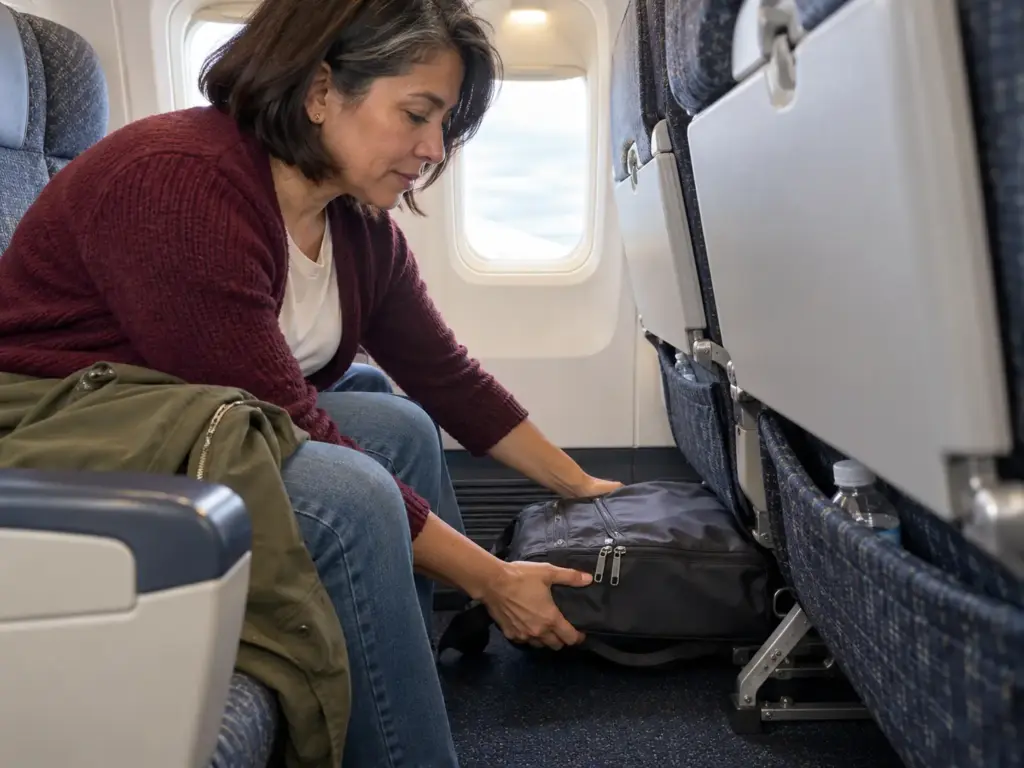
Two carry-ons at the limit
The HULSIN 20-inch hardside lists 22 x 14 x 9 inches with the wheels and handles, and 6 pounds (2.7 kg) empty. That’s United’s limit to the inch, with no margin, so a fixed shell is a better match than a soft bag because nothing grows at the door. The listing states a 10-year manufacturer warranty that names airline handling among the covered causes. Durability is mixed, though, and the handle is where the breakage tends to show up, so that warranty carries real weight in the decision.
The BAGSMART 20-inch expandable spinner lists the same 22 x 14 x 9 inches closed, at 6.83 pounds (3.1 kg) empty. Its zipper adds 1.6 inches per the listing, which puts the depth around 10.6 inches and over United’s 9. It has to travel closed, and a bag that’s full to the point of needing the expansion is already too full for the sizer. A little over a quarter of the durability comments on its listing are negative, and the lock button is the named weak spot.
Two personal item bags at the limit
For Basic Economy, the free fallback is a personal item bag cut to United’s size. The BAGZY 9 by 10 by 17 personal item backpack lists 17 x 10 x 9 inches (43 x 25 x 22 cm) and 21 liters, which equals United’s personal item exactly. The listing gives no weight. It has few ratings so far, and a zipper complaint sits among them, which makes it a flag rather than a pattern yet.
The palamea 17 by 10 by 9 backpack lists the same size at 20 liters and 0.77 pounds (0.35 kg), and it sits in a lower price tier than the BAGZY. The strap is thin and gets uncomfortable on a long carry. Both have no margin, so a full bag will bulge past the 9-inch depth just like a full carry-on does.
Tonight’s Job: Measure the Packed Bag, Then Read the Fare’s Bag Line
The numbers to carry out of this: the carry-on is 9 x 14 x 22 inches with the handle and wheels counted, the personal item is 9 x 10 x 17 inches, Basic Economy usually means the personal item only, and the bin and the aircraft can overrule a bag that measures right. A gate check on Basic Economy costs $75 for tickets bought on or after April 3, 2026, according to United.
Limits and fees change, so open United’s page again before your next booking, and measure the bag packed, not empty, once the wheels and zipper have seen a few trips. Tonight, pack the bag the way it will actually travel, measure it at the fullest point, and read the bag line of your fare. If the carry-on isn’t in it, your plan is the personal item, and you’ll know it worked when that one bag holds everything you can’t afford to have checked. For that bag, United’s personal item size is the next thing to look at.
Frequently Asked Questions
01What if a carry-on is 1 inch too big for United?
An inch over on any side is over the limit as United prints it, so the bin, the fare and the boarding door decide what happens. Empty the front pocket and measure again. On Basic Economy, a gate check costs $75 for tickets bought on or after April 3, 2026 (United, October 2026).
02What is the carry-on size for United Airlines now?
United’s carry-on page, read in October 2026, gives 9 x 14 x 22 inches (23 x 35 x 56 cm), with the handle and wheels included. The personal item is 9 x 10 x 17 inches (22 x 25 x 43 cm), under the seat in front.
03Will United allow a 23-inch carry-on?
No, because the longest side United prints is 22 inches, so a 23-inch bag is an inch over, and the sizer reads the whole bag with wheels and handles. A smaller bag or the personal item is the safer move (United, October 2026).
04Is United really strict about carry-on size?
The limit is printed and the sizer exists, but enforcement at the door is uneven, and a full bin often decides before the tape measure does. United names three triggers: no overhead space, a bag over the size limit, or too many bags (United, October 2026).
Leave a comment