
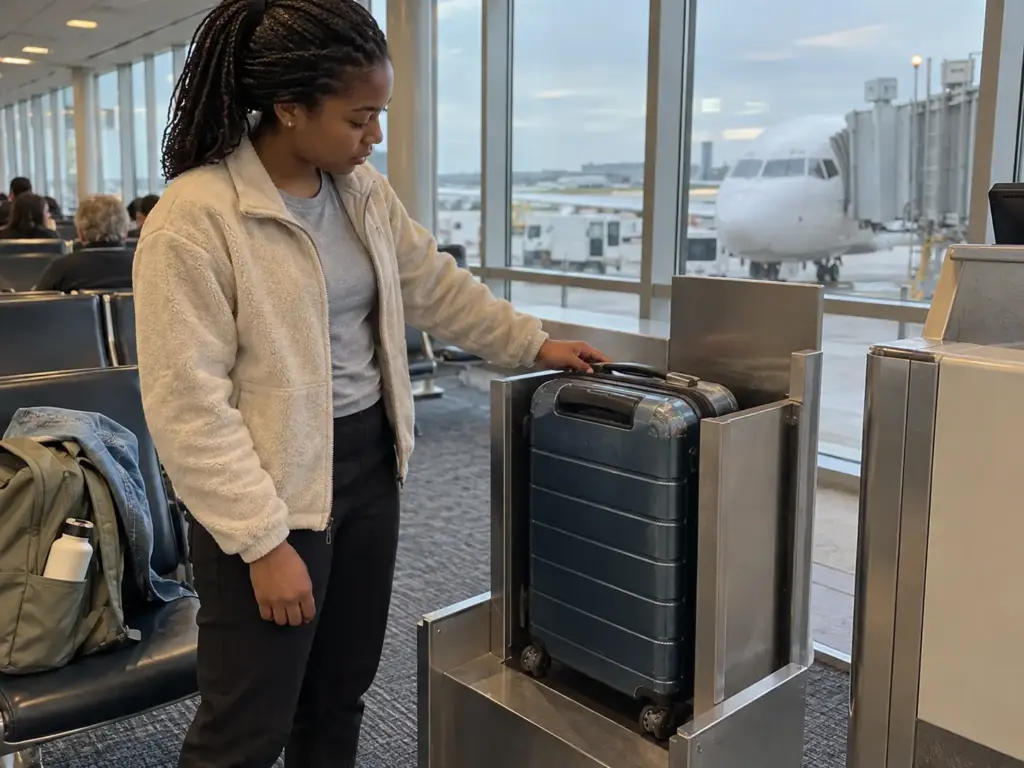
A suitcase labeled carry-on size carries whatever number its maker chose to print, but the sizer at the airport measures the bag with its wheels and handle still on. That’s why the carry-on size limits by airline below come straight from each airline’s own page, as printed on October 30, 2026. After the table you’ll find how to measure, the carriers that allow a bigger bag, the fares and flights where a bag that fits still doesn’t get on, the personal item, weight and international trips, and what you can pack inside once the bag passes.
Most large U.S. airlines publish 22 x 14 x 9 inches (56 x 36 x 23 cm) with wheels and handles counted; Southwest and Frontier publish 24 x 16 x 10, and Allegiant 22 x 16 x 10.
| Carry-on size, in (cm), wheels and handles counted | Airlines that publish it | Also on the page |
|---|---|---|
| 22 x 14 x 9 (56 x 36 x 23) | American, Delta, JetBlue, Alaska | Delta and Alaska also state 45 linear inches (114 cm) |
| 9 x 14 x 22 (23 x 35 x 56) | United | The same size, written with the depth first |
| 24 x 16 x 10 (61 x 41 x 25) | Southwest, Frontier | Frontier adds a 35 lb (16 kg) weight limit |
| 10 x 16 x 22 (25 x 40 x 55) | Allegiant | The carry-on is paid; the personal item is free |
| 9 x 15.5 x 21.5 (23 x 40 x 55) | Air Canada | Economy Basic can allow only a personal item |
Each size is the airline’s own wording, as printed on each airline’s carry-on page on October 30, 2026. Centimeters that a page does not print (Southwest, Frontier, Alaska) are converted from inches.
The two slots: what counts as your carry-on and what counts as your personal item
Every size in this guide describes one of two things: the bag that goes in the overhead bin, or the item that goes under the seat in front of you. Airlines count them separately, and a few things use up a slot even though they don’t look like a bag.
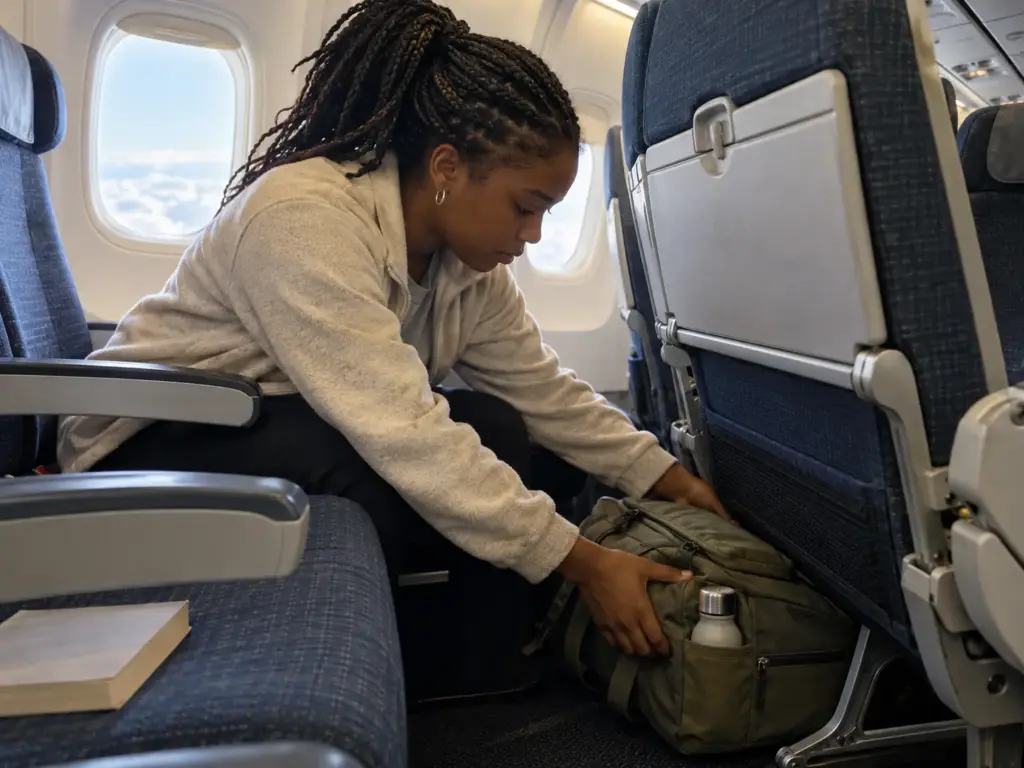
One bag for the bin, one item under the seat
Alaska’s page sums up the allowance in one line: one carry-on bag plus one personal item, such as a purse, briefcase or laptop bag. At least one of the two has to fit under the seat in front of you, and you need to be able to lift your own bag into the bin (as of October 30, 2026). Other airlines word it differently, but the idea is the same.
Counting is where trips go sideways. A roller, a backpack, a camera bag and a tote are four things, and only two get on. A second bag hanging from the roller’s handle at the boarding door still counts as a second bag, and it’s usually the first one to get a gate-check tag.
Your underseat bag is also the only one you can reach in flight, so anything you can’t afford to lose, or will want before landing, should go in there. The two size limits aren’t the same, and how the two limits differ sets them side by side.
A pet carrier takes a slot
Southwest’s carry-on policy page says a pet carrier counts as either your carry-on bag or your personal item. So if your animal flies in a carrier, it takes one of your two slots, and your own bag has to fit in the other. The carrier also has to meet the under-seat size of the airline you’re flying, and every airline writes its own pet rules, so check that airline’s pet page instead of assuming this one covers it.
Medicine stays in the item that stays with you
United’s own carry-on page tells passengers to keep medication, keys and other essentials in the personal item in case the bag gets gate-checked. A gate-checked roller leaves your hands at the jet bridge, so anything you’ll need during the trip belongs in the bag that stays with you.
What goes into a person or an animal is outside this guide. Ask a veterinarian about anything an animal might be given for the flight, and ask a doctor or a pharmacist about any medicine you’re unsure how to carry or take. The only bag question left is where the medicine rides, and the answer is the item under the seat.
Wheels and handles count, so measure the packed bag with both attached
The size on a tag is whatever the maker decided to print. What actually counts is the bag measured with everything attached, and every airline in the table counts the wheels and the handle.
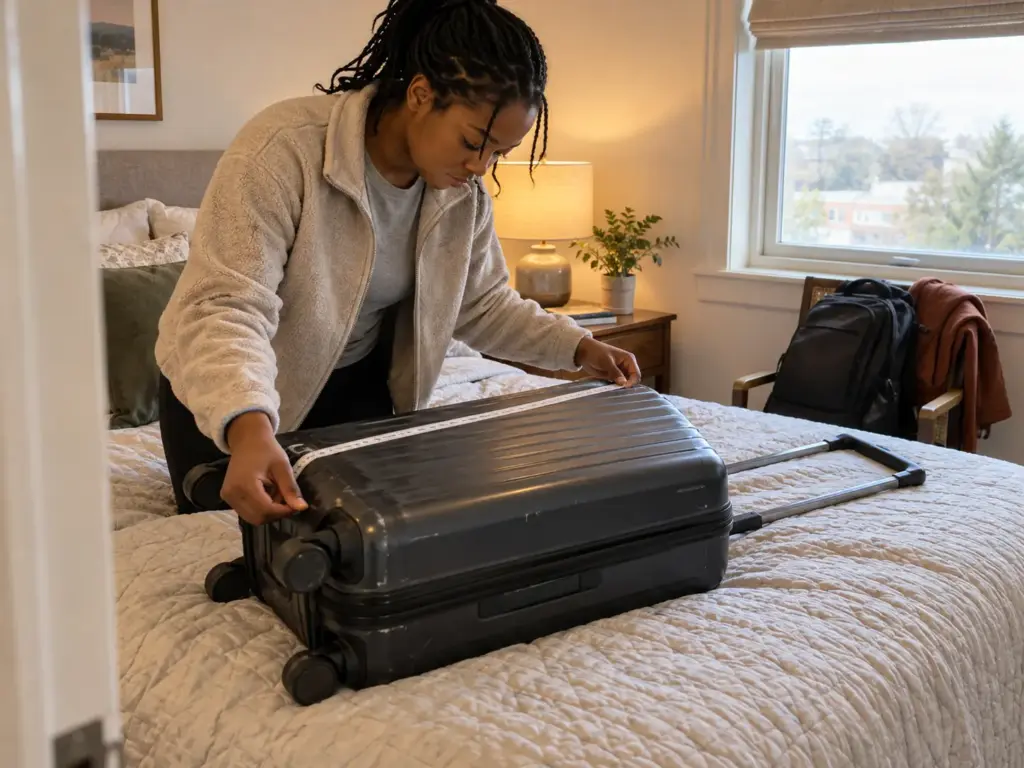
What the tag measures and what the sizer measures
The sizer at the airport is a metal frame: your bag either slides in or it doesn’t. It can’t read the tag. It takes in the wheels at the bottom, the telescoping handle at the top, the grab handle on the side and whatever’s stuffed in the front pocket. A listing that only gives the shell’s size can be an inch or two short of the real thing.
American, Delta, United, Southwest, JetBlue, Alaska, Allegiant and Air Canada all say on their pages that the carry-on size includes wheels and handles, and Southwest adds “any attachments” to the list. Frontier says the same for the personal item, straps included. If you’re unsure where the tape starts on your own bag, whether wheels and handles count walks through it.
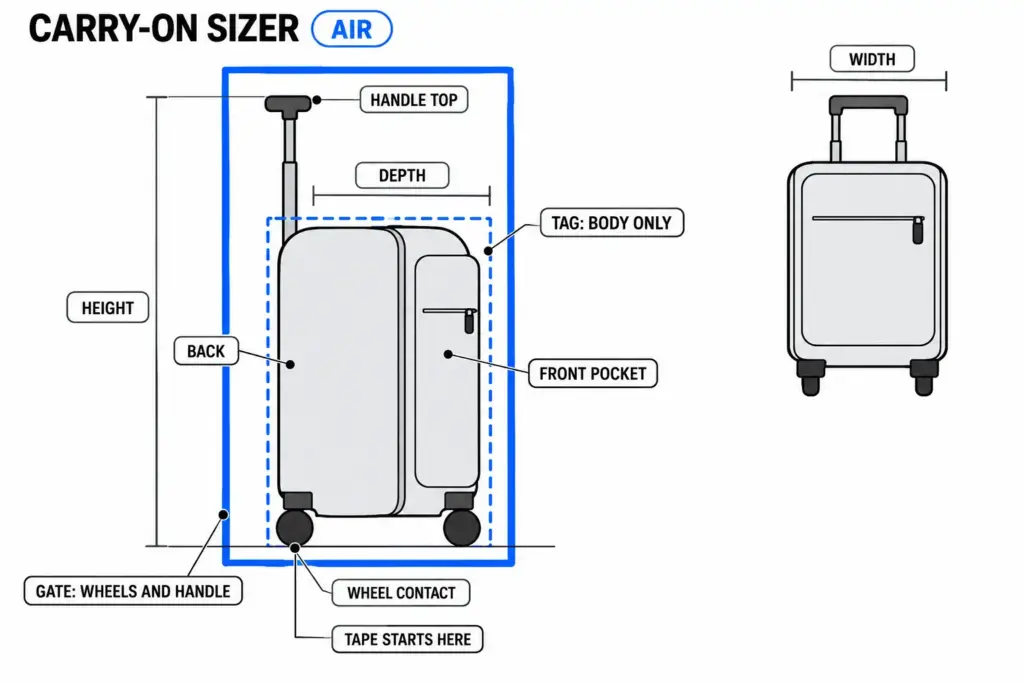
Depth is where you have the least room: 9 inches on American, Delta, JetBlue, Alaska and United, and 10 on Southwest, Frontier and Allegiant.
It’s also the measurement a soft bag changes most. An expansion zipper adds depth the listing never counted, and a front pocket full of chargers and a jacket pushes the same bag out past the frame. A soft bag with stuffed outside pockets might only just squeeze into the sizer, and a top handle can poke out past the edge even when the numbers on paper pass. That’s why bags that label themselves carry-on and still fail the sizer are so common.
Measure the bag after it’s packed and zipped, not before. Stand it on the floor on its wheels, run the tape up to the highest point with the telescoping handle pushed in, then measure the depth across the fullest part of the front pocket. Depth is the number that changes most, and the limits in this guide only give you 9 or 10 inches (23 or 25 cm) for it.
Delta’s two lines and the way United writes the same box
Delta writes its carry-on limit twice. First, no side can go over 22 x 14 x 9 inches (56 x 35 x 23 cm), handles and wheels included. Then Delta’s own carry-on page, which sets the combined total adds 45 linear inches with this line: “Combined length + width + height of baggage must not exceed 45 linear inches (114 cm)”.
Do the math before you lean on that second line. 22 + 14 + 9 is exactly 45, so the total gives a bag that already fits nothing extra, and it can’t rescue one that doesn’t. A 23 x 13 x 9 bag adds up to 45 and still fails on the 22-inch side. Alaska’s page gives both versions too.
United writes its carry-on as 9 x 14 x 22 inches, which is just 22 x 14 x 9 stood on end. Allegiant does the same with 10 x 16 x 22 for what other pages would write as 22 x 16 x 10. The order of the numbers is only a labeling choice, so when you check your bag, match the longest side to the longest, the middle to the middle and the shortest to the shortest.
The free fixes, one at a time, before any new bag
A bag that’s over the limit doesn’t always need replacing. Four changes cost nothing; try them one by one and measure again after each. Take out whatever’s in the outside pockets and move it to your personal item or your jacket. Zip an expandable bag closed and leave it that way.
Repack so a soft bag stops bulging, with heavy flat things against the back panel and soft ones filling the corners. Then pack less, and wear your bulkiest layer through the checkpoint.
If you’ve done all four and the tape still reads over, it’s time to think about another bag, and how to tell if your bag is too big goes through the measuring and the sizes that fail.
Carrier by carrier: the numbers each airline publishes
The table at the top groups airlines by the size they print. This one gives each airline its own row, with the personal item, any weight limit and the date each page was read.
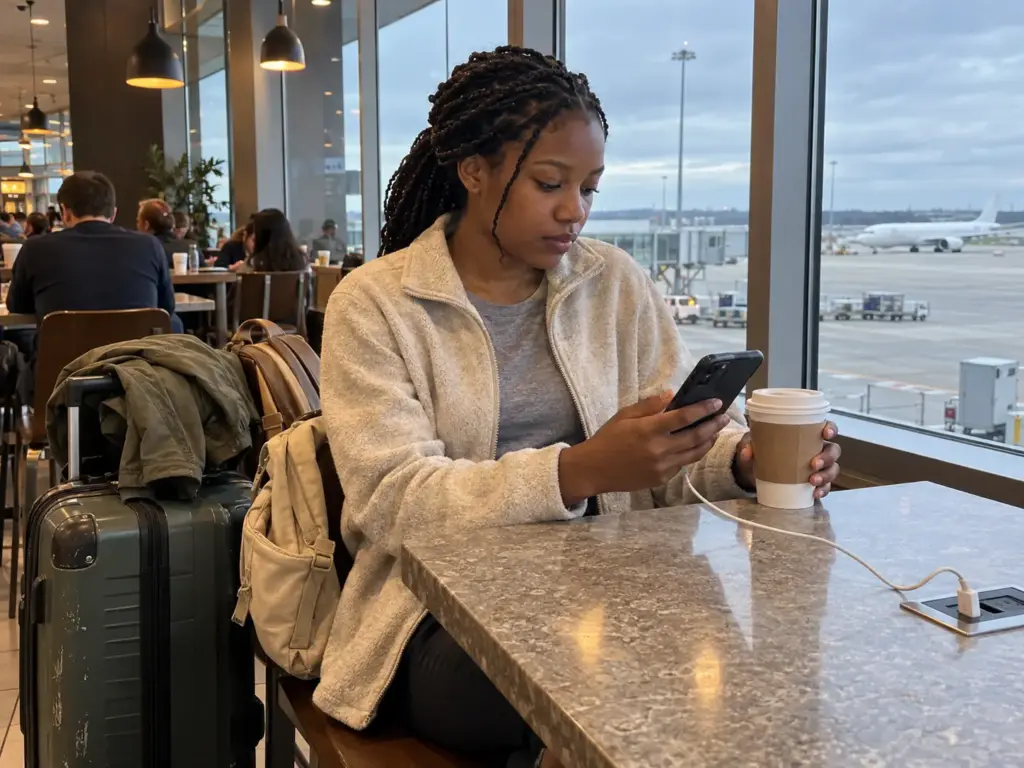
The rule table
| Airline | Carry-on, in (cm) | Personal item, in (cm) | Weight |
|---|---|---|---|
| American | 22 x 14 x 9 (56 x 36 x 23) | 18 x 14 x 8 (45 x 35 x 20) | None stated |
| Delta | 22 x 14 x 9 (56 x 35 x 23); 45 linear (114) | No size published | None stated |
| United | 9 x 14 x 22 (23 x 35 x 56) | 9 x 10 x 17 (22 x 25 x 43) | None stated |
| JetBlue | 22 x 14 x 9 (56 x 36 x 23) | 17 x 13 x 8 (43 x 33 x 20) | No limit if you can lift it |
| Alaska | 22 x 14 x 9 (56 x 36 x 23); 45 linear | Examples, no size | Lift it yourself |
| Southwest | 24 x 16 x 10 (61 x 41 x 25) | No size published | None stated |
| Frontier | 24 x 16 x 10 (61 x 41 x 25) | 14 H x 18 W x 8 D (36 x 46 x 20) | 35 lb (16 kg) |
| Allegiant | 10 x 16 x 22 (25 x 40 x 55), paid | 8 x 14 x 18 (20 x 35 x 45), free | None stated |
| Air Canada | 9 x 15.5 x 21.5 (23 x 40 x 55) | 13 x 17 x 6 (33 x 43 x 16) | No limit; lift it yourself |
Sizes in inches with centimeters in brackets, wheels and handles counted, exactly as printed on each airline’s carry-on page on October 30, 2026. “None stated” means the airline’s page prints no weight figure. Centimeters for Frontier and Alaska are converted from inches.
American’s own carry-on page gives the standard 22 x 14 x 9 and the 18 x 14 x 8 inch personal item, and everything on the American limit has a dedicated page. The United page and the Delta limit in full cover the other two big airlines. American’s page adds one more number, for a soft-sided garment bag: it can’t go over 51 inches (130 cm) in total, length plus width plus height.
Where two numbers look alike but are not
The personal-item column is the one that trips people up. JetBlue’s carry-on page sets 17 x 13 x 8 inches, an inch shorter and an inch narrower than American’s 18 x 14 x 8. Frontier prints 14 H x 18 W x 8 D, which is American’s size with the sides listed in a different order. Allegiant’s 8 x 14 x 18 is the same again.
United’s 9 x 10 x 17 is a different shape altogether, and Air Canada’s 13 x 17 x 6 is the shallowest of the bunch.
Southwest and Delta publish no personal-item dimensions, and Alaska gives examples (a purse, a briefcase, a laptop bag) instead of a size. No published size doesn’t mean no limit, though: the item still has to fit under the seat in front of you.
When your trip involves two airlines, pack to the stricter one’s numbers; the fares and planes further down show where that matters.
The carriers that allow a bigger box
Most airlines use 22 x 14 x 9, but it isn’t a law. Southwest and Frontier publish a larger carry-on, and what you give up for the extra room shows up in the fare and, on one of them, in a weight limit.
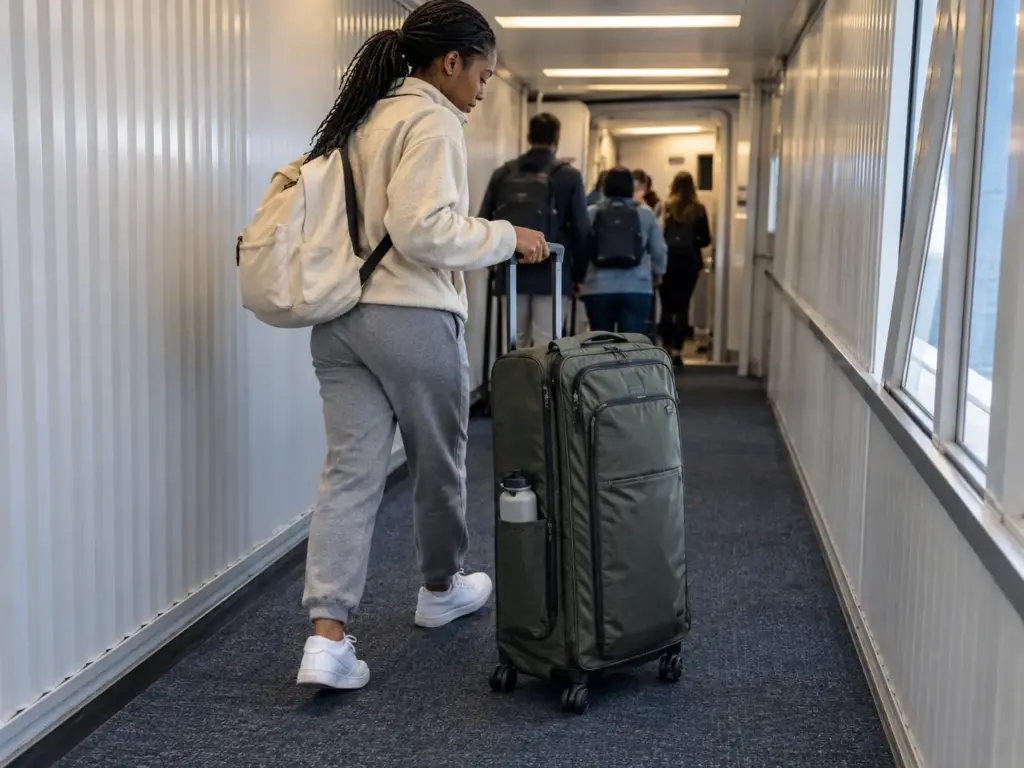
Southwest and Frontier: 24 x 16 x 10
Southwest’s carry-on page lists 24 x 16 x 10 inches (61 x 41 x 25 cm), says wheels, handles and any attachments count toward those dimensions, and prints no personal-item size; the Southwest limit has its own page with the details. Frontier’s bag size and weight page gives the same carry-on as 24 H x 16 W x 10 D and caps it at 35 lb (16 kg).
A 24-inch roller that passes on those two won’t pass the 22 x 14 x 9 limit of the next carrier on the same ticket. Whether a 24-inch suitcase can go on comes down to the strictest airline on your trip. Southwest’s page also warns that when your itinerary includes a partner airline, the partner’s carry-on and personal-item rules may be different.
Allegiant: a different box and a fee
Allegiant’s carry-on is 10 x 16 x 22 inches (25 x 40 x 55 cm) and you pay for it, while the personal item, 8 x 14 x 18 inches (20 x 35 x 45 cm), is free. Allegiant shows the amount of that fee on its manage-travel pages, not on its baggage page. Its carry-on size is two inches wider and an inch deeper than the standard 22 x 14 x 9.
On low-cost carriers, how often a personal item gets sent to the gate check depends on the route and on the agent. You can’t plan around that, but you can plan around the printed size, which doesn’t change. A bag that fits it doesn’t depend on who’s working the door. If you want the three budget carriers’ personal-item sizes in one place, the budget airlines’ personal-item sizes has them.
Spirit: the page decides
Spirit publishes its carry-on and personal-item sizes on its own site, and that’s the page to pack to, checked against the fare on your ticket; a number from a third-party chart is how a bag ends up an inch off. Spirit’s carry-on limit goes through the airline in detail.
Where the number stops applying: the cheapest fare, the small plane and the second airline
A size limit tells you what kind of bag is allowed on board. Whether your bag gets on at all comes down to three things: the fare, the plane and the other airline on the ticket.
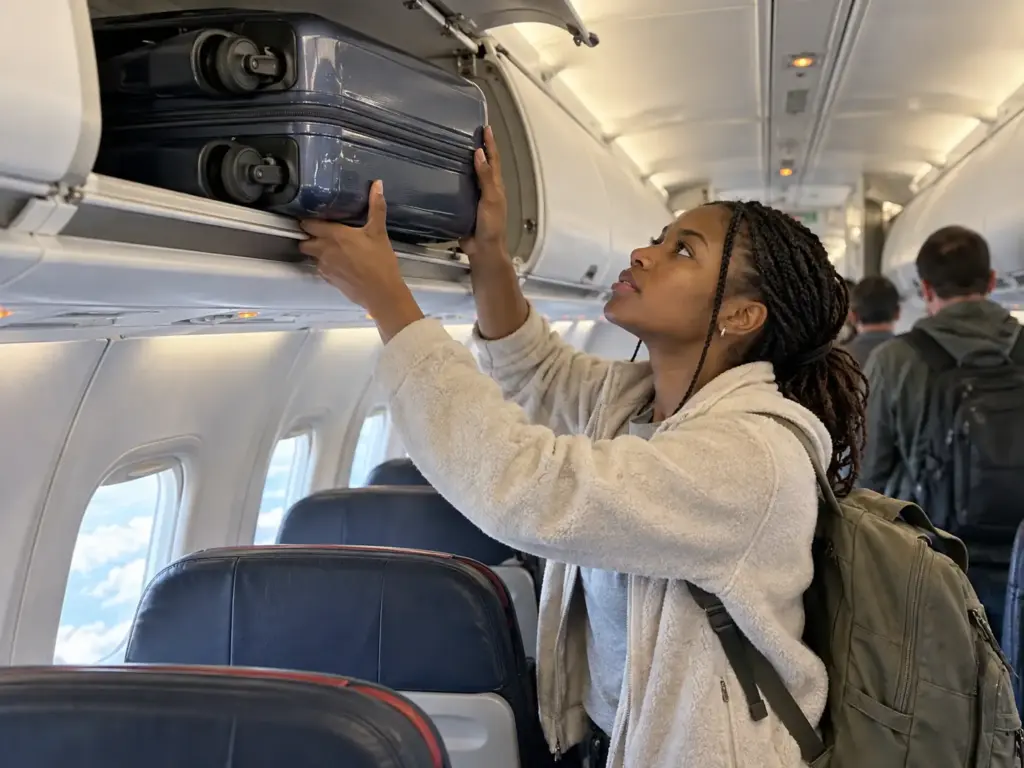
The fare that takes the bin away
United’s page on Basic Economy says that on most trips you get one personal item, and every other bag has to be checked. At that point, a roller you measured perfectly at home is a bag to check, however well it fits the frame. Air Canada’s carry-on page says Economy Basic fares bought on or after January 3, 2025 allow only one personal item on board on some itineraries, so the answer depends on the route as well as the fare.
Bag fees depend on the fare, the route and when you pay, so the airline’s page is the place to see the current amount.
Before you pay, the booking page shows the fare’s baggage line and the aircraft type, and those two lines matter more than your tape measure. Check both once, then plan your bag for the smallest plane and the cheapest fare on the itinerary.
The regional jet that takes the roller
Delta’s page says passengers on Delta Connection flights, including flights with 50 seats or fewer, may carry only personal items, so the roller gets claimed at the gate for the cargo hold. American’s page says that on its American Eagle regional planes, a carry-on larger than the personal-item dimensions has to be valeted before boarding, and that Embraer ERJ-175 planes allow carry-ons and offer no valet. United’s page says CommutAir passengers can bring only one personal item, while the other United Express carriers allow carry-ons with limited space.
A bag that goes into the hold at the jet bridge travels with the checked luggage, so your medicine, charger and documents need to be in the personal item before boarding starts, because the bag leaves your hands at the door. When it’s your roller’s turn, what happens at the gate when a bag is over covers that moment.
The strictest airline on the trip decides
A trip on two airlines is only as generous as the stricter one. JetBlue’s page says that, in general, the first airline on the first leg of each direction sets the bag rules, and Southwest’s says a partner airline’s rules may differ. Neither one promises that a bag that passes the first leg will pass the second. The safe move is to size your bag for the smaller of the two limits and check each operating carrier’s page for its own leg.
That also answers the two-inch question. A bag that’s only a little over the printed size has no leeway at a sizer built to that size, and a bag that is only a little over is better dealt with at home, with the tape.
The personal item: a smaller box, and the one pick
Whatever fare you booked, the personal item is the one bag that always gets on, and its size limit is smaller and less consistent than the carry-on’s.
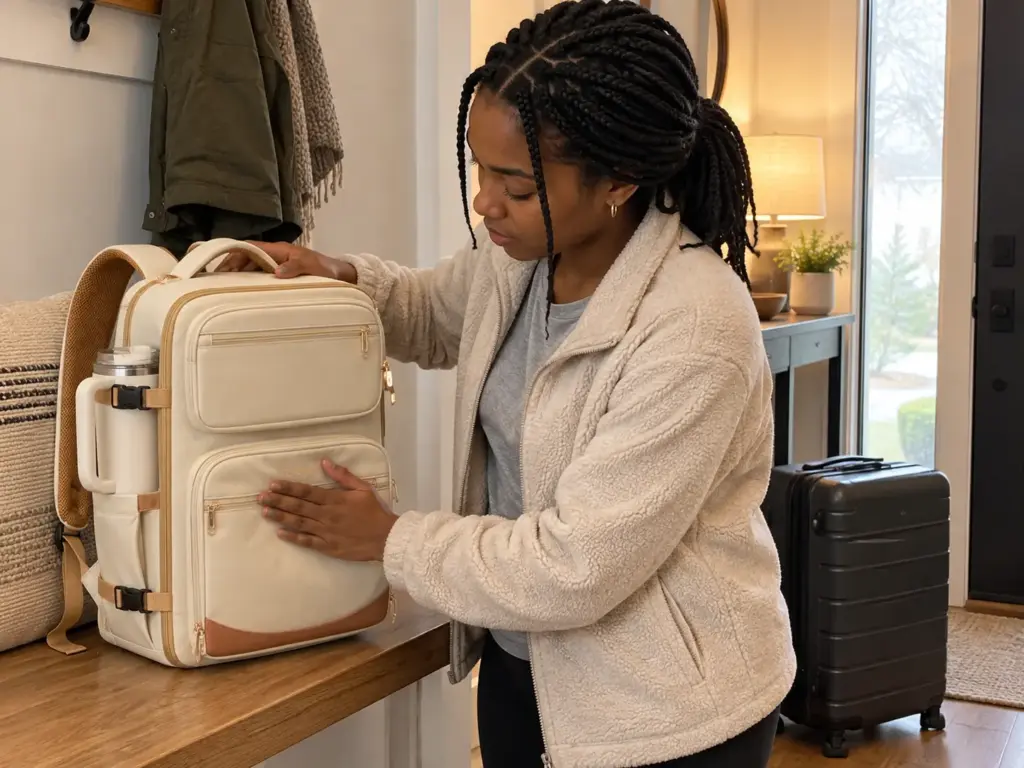
Four boxes, one rule: it goes under the seat
Six airlines print a personal item size, and between them they land on four different ones, all meant for the space under the seat in front of you:
- American: 18 x 14 x 8 inches (45 x 35 x 20 cm).
- Frontier: 14 H x 18 W x 8 D inches, handles, wheels and straps included.
- Allegiant: 8 x 14 x 18 inches (20 x 35 x 45 cm), free.
- JetBlue: 17 x 13 x 8 inches (43 x 33 x 20 cm).
- United: 9 x 10 x 17 inches (22 x 25 x 43 cm).
- Air Canada: 33 x 43 x 16 cm (13 x 17 x 6 inches).
Southwest, Delta and Alaska print no size, as mentioned above. The full list by airline is at personal-item size by airline. On a Basic fare with no bin access, this is your only bag, and how the carry-on and personal-item limits differ helps when you’re deciding which of the two to fill first.
Start with the free fix. A backpack you already own that measures right with the pockets empty is already a personal item. If it doesn’t, pack less in it and let your jacket take the bulk.
The one pick, and the box it does and does not pass
If buying something really is the answer, the Taygeer personal-item backpack is the one we chose. The listing gives it as 18 x 14 x 8 inches (about 46 x 36 x 20 cm) and 40 liters. Next to the printed sizes above, that matches American, Frontier and Allegiant, and misses JetBlue’s 17 x 13 x 8, United’s 9 x 10 x 17 and Air Canada’s 13 x 17 x 6.
Those dimensions are the listing’s own figure, held up against the airline limits above, and buyers’ reviews point to one weak spot.
That weak spot is depth. With the outside pockets full, the bag runs past 8 inches (20 cm) deep, only just fits the sizer and can have its top handle stick out past the frame. The math explains it: an 18 x 14 x 8 inch shape holds about 33 liters, so a 40-liter label only works if the bag bulges past its printed dimensions when it’s full, and the pockets are where that happens. It’s a good fit for trips where the strictest airline is American, Frontier or Allegiant, and the wrong pick for a ticket that includes JetBlue, United or Air Canada.
Weight and the international leg
Size is the number everyone checks. A few airlines also set a weight limit, and an airline’s international rules can be stricter than the domestic page you looked at.
The weight limits that are published
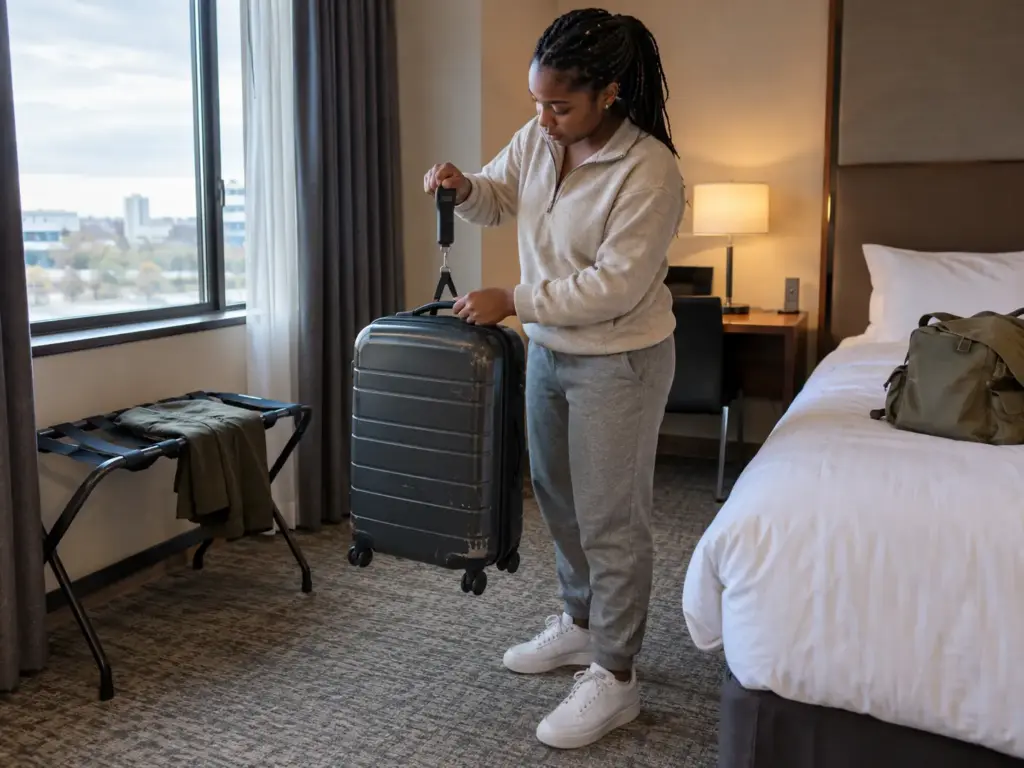
Frontier’s page says a carry-on can weigh no more than 35 lb (16 kg). JetBlue’s says there’s no weight limit as long as you can lift the bag. Air Canada’s page says no weight limit applies to carry-on baggage, but the bag has to be light enough to put in the overhead bin without help, and Alaska’s page asks the same of passengers. American, Delta, United, Southwest and Allegiant print no carry-on weight.
That lifting line is a rule too. If you can’t get the bag into the bin by yourself, the airline can send it to the hold, whatever the scale says. The carry-on weight limits and why they exist explains the numbers, and whether the gate weighs carry-ons tells you what to expect at the airport.
Weigh the bag the way it’ll board, with the day’s liquids, the charger and your layers inside. Frontier’s 35 lb (16 kg) is the only carry-on weight in this guide with a published number behind it, so a packed bag well under that is also an easy lift on the airlines that don’t print one.
An international ticket changes the page to read
A weight limit belongs to the route as much as to the airline, so the domestic page you checked at home may not be the one that applies to an international leg. For any trip beyond the United States, the airline operating the flight publishes a separate page, and international carry-on size limits lays out how those differ.
What rides inside a bag that fits: liquids and batteries
A bag that passes the sizer can still get stopped at the checkpoint. The airline measures the bag; the TSA and the FAA care about what’s inside it.

The clear bag at the checkpoint
TSA’s liquids rule, as the agency words it, allows a quart-size bag of liquids, aerosols, gels, creams and pastes, in travel-sized containers of 3.4 ounces (100 milliliters) or less per item, written 3.4 oz on most labels. The limit applies to the container, so the size printed on each bottle is what counts, and the clear bag is the one thing that comes out of the carry-on to be looked at. If your toiletry kit is packed at the bottom of the roller, you’ll be digging it out in line. For what belongs in that clear bag, the 3-1-1 rule explained is the next stop.
Power banks and lithium batteries stay with you
According to the FAA’s own PackSafe chart, which states the cabin rule for spare batteries, “Power banks, spare batteries, and lithium batteries with a capacity of less than 160 Wh must remain with passengers in the aircraft cabin.” The same page says batteries over 160 watt hours aren’t allowed on passenger aircraft at all. So the battery goes in your carry-on or personal item, never in a checked bag, and a roller that might get gate-checked is the wrong place for it.
American’s valet page tells passengers to remove batteries and other restricted items before the bag is checked. On a regional flight, take the power bank out of the roller at home and put it in the bag that stays with you, along with the clear bag.
Measure the packed bag, then check the page for your fare
For most airlines the standard size is 22 x 14 x 9 inches with the wheels and handles counted, and Southwest, Frontier and Allegiant publish bigger ones. The fare, the plane and the other airline on your ticket can all keep a bag that fits out of the bin. The personal item is the one bag that always gets on, and it’s smaller than most people think.
Airline pages change, so the numbers here are a snapshot from October 30, 2026; open the page for your fare before your next booking. After the trip, check the wheels and the zipper pulls, since those are the first parts to loosen, and weigh the bag again once the souvenirs are in.
Tonight, before you finish packing, put the tape on the floor at the wheels, run it to the top of the pushed-in handle, then across the fullest pocket. If all three numbers are at or under the smallest limit on your ticket, you’re set; if the depth is over, empty that pocket and measure again.
Frequently Asked Questions
01What is the new carry-on size?
Most large U.S. airlines list 22 x 14 x 9 inches (56 x 36 x 23 cm) as the standard carry-on size limit, wheels and handles included, with no change as of October 30, 2026. Southwest and Frontier publish 24 x 16 x 10.
02What if a carry-on is 2 inches too big?
A bag two inches over the printed size can be turned away at the sizer, tagged at the gate or sent to the hold, depending on the airline. Empty the outside pockets, zip an expandable bag closed, repack and measure again. On American’s regional planes, an over-limit bag gets valeted. A carry-on that is only slightly too big has the details.
03Do wheels and handles count toward carry-on size?
Yes. American, Delta, United, Southwest, JetBlue, Alaska, Allegiant and Air Canada all say the carry-on size includes wheels and handles; Frontier says it for the personal item. If you measure only the shell, the bag can still fail the sizer.
04Does Basic Economy include a carry-on bag?
It depends on the airline and the trip. United’s page says most Basic Economy trips allow one personal item, and Air Canada’s Economy Basic allows only a personal item on some itineraries (both as of October 30, 2026). The fare’s baggage line on the booking page decides.
05Is there a weight limit for carry-on bags?
Only some airlines publish one. Frontier sets 35 lb (16 kg), while JetBlue and Air Canada print no limit but expect you to lift the bag into the bin yourself.
Leave a comment